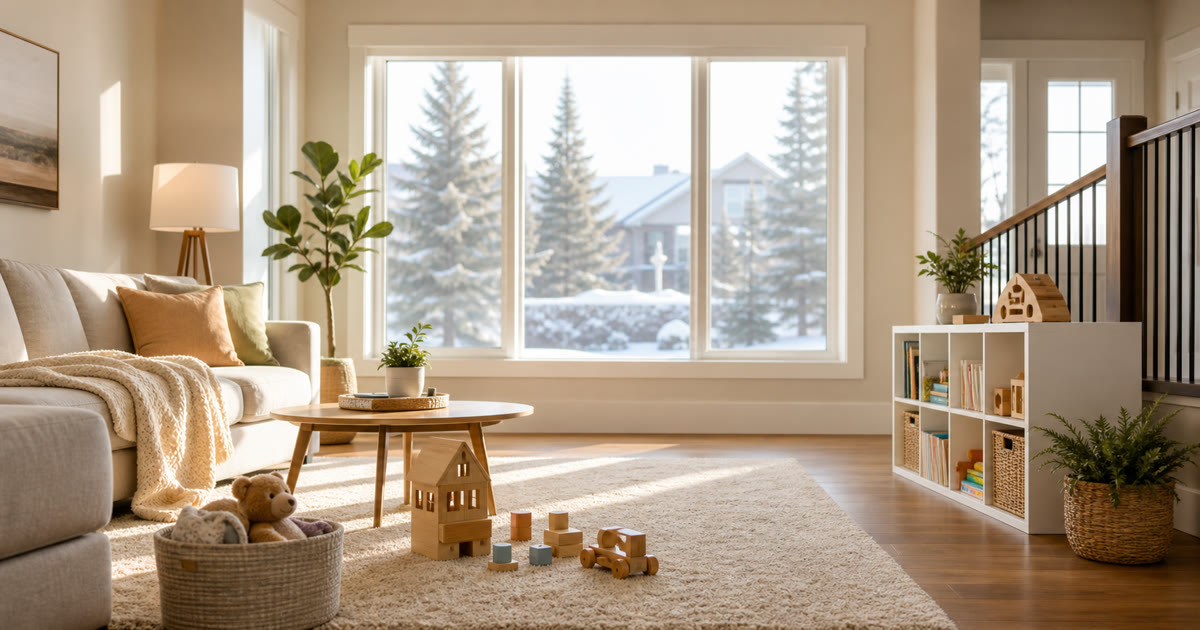
Radon and Children: Protecting Your Calgary Family from an Invisible Risk
Every Calgary parent worries about their children's safety: traffic, nutrition, the right school, the right neighbourhood. Radon rarely makes that list — not because it is harmless, but because it is invisible. You cannot see it, smell it, or taste it. Yet for children in Calgary homes, radon is a real health risk, and one of the most preventable ones you face.
Why Children Are More Vulnerable to Radon
Radon harms the lungs by releasing tiny radioactive particles as it decays. These particles — called radon progeny — lodge in lung tissue and bombard sensitive cells with radiation over time, damaging DNA and, after many years, potentially causing lung cancer.
Children are not just smaller adults when it comes to radon exposure. Three factors make them more vulnerable:
Higher breathing rate. Children breathe more frequently per kilogram of body weight than adults. A toddler playing in a Calgary basement playroom inhales considerably more air — and with it, more radon — relative to their size than a parent sitting in the same room.
Developing lungs. A child's lungs are still growing and dividing cells rapidly. Rapidly dividing tissue is inherently more sensitive to radiation damage. The same dose of radiation produces a greater biological effect in a developing respiratory system than in a fully mature one.
Time spent at home. Children — especially young ones — spend a substantial portion of their day at home: sleeping in bedrooms, playing in basements, doing homework in dens. In a Calgary home with elevated radon, this adds up to years of cumulative exposure. A child who grows up in the same Calgary house from birth to age eighteen will have breathed roughly 70,000 hours of indoor air before leaving for university. That is an enormous exposure window.
Where Children Encounter Radon in Calgary Homes
Calgary's geography and housing patterns create specific hotspots for childhood radon exposure. Alberta sits on uranium-rich glacial deposits that generate radon continuously. In neighbourhoods across the city — from Brentwood in the northwest to Haysboro in the south, from Falconridge in the northeast to Acadia in the southwest — the geology beneath the surface produces a steady upward flow of radon gas.
The most concentrated exposure happens in basements and ground-floor rooms. In Calgary, basements are often finished as family rooms, play areas, guest bedrooms, and home offices. A basement playroom where children spend hours building blocks or watching cartoons is, in many Calgary homes, the room with the highest radon concentration. Placing a child's bedroom in the basement — a common choice in Calgary's real estate market, where below-grade bedrooms add value — can inadvertently create a daily, eight-to-ten-hour exposure window in the highest-radon zone of the entire house.
Even above-grade rooms are not immune. Alberta homes are built tight against cold winters, and Calgary's heating season runs from October through April or longer. When the furnace runs, it creates negative pressure that actively draws soil gas — including radon — upward through foundation cracks and utility openings. A child's main-floor bedroom in a tight Calgary bungalow may have levels surprisingly close to the basement.
The Long Shadow: Childhood Exposure and Adult Lung Cancer
Radon-induced lung cancer does not appear overnight. The latency period — the time between exposure and diagnosis — typically spans fifteen to thirty years. This creates a cruel arithmetic: the radon children breathe in a Calgary home today may contribute to a lung cancer diagnosis in their thirties or forties, when the connection to their childhood home is long forgotten.
This is precisely why Health Canada and the World Health Organization identify radon as a priority for family homes. The roughly 3,200 lung cancer deaths attributed to radon each year in Canada are overwhelmingly the result of decades of exposure, often beginning in childhood homes where testing never happened.
The encouraging counterpoint is that radon-induced lung cancer is almost entirely preventable. Unlike most environmental carcinogens, radon is measurable with precision and removable with proven technology. The risk is real, but the solution is straightforward.
What Calgary Parents Can Do
1. Test Your Home — Especially Where Children Sleep and Play
A long-term radon test over 90 days during the heating season gives the most accurate picture of your family's average exposure. Place detectors in the lowest lived-in level of your Calgary home — the basement playroom, the below-grade bedroom, the ground-floor family room. Health Canada recommends action at levels above 200 becquerels per cubic metre (Bq/m³), but because no level is completely risk-free, driving levels as low as reasonably achievable is the goal when children are involved.
2. Act Promptly on Results Above the Guideline
If your Calgary home tests above 200 Bq/m³, remediation should be a priority. For homes with young children — where the exposure window stretches decades into the future — some families choose to mitigate even at levels approaching the guideline. A professional radon mitigation system using sub-slab depressurization typically brings levels down by 80 to 99 percent, and in many Calgary homes, that means dropping from hundreds of Bq/m³ to well below 50.
3. Test After Mitigation — Every Time
A system is only as good as its verified result. After mitigation, a follow-up test confirms the new, lower level. At that point, you have documented proof that your Calgary home is safe. No more guessing.
4. If You Rent, Ask the Landlord
Tenants in Alberta have the right to a safe living environment. If you rent a home or basement suite in Calgary and are concerned about radon, request testing from your landlord. Health Canada provides radon information specifically for tenants.
5. Re-Test Every Few Years and After Renovations
Radon levels can shift with changes to your home: a new furnace, basement renovations, foundation settling, or even neighbouring construction can alter airflow and entry points. Re-testing every few years ensures your family's protection stays current.
Why Calgary Homes Deserve Extra Vigilance
Not every region has the same radon risk. Alberta is consistently identified as one of the higher-radon-potential provinces in Canada. Large-scale studies — including Health Canada's Cross-Canada Radon Survey and the University of Calgary's outreach programs — have found that a significant percentage of Calgary homes test above the 200 Bq/m³ guideline. Estimates typically place 10 to 15 percent of Prairie-region homes above the action level, and in some Calgary communities, the numbers run higher.
Add to this the fact that Calgary homes are occupied year-round and sealed tight against winter — the stack effect that pushes radon indoors is strongest during the months when families spend the most time inside — and the case for testing every Calgary family home becomes clear.
Peace of Mind Is the Best Investment
Parents invest in car seats, helmets, and smoke detectors without hesitation. Radon testing and mitigation belong in the same category: a modest expense that protects against a large and largely hidden risk. Your child will never know the difference between a home with radon and a home without it — but their lungs will. And decades from now, the decision to test your Calgary home could be one of the quietest and most consequential choices you ever made for your family.
At Onyx Radon, our C-NRPP certified team specializes in helping Calgary families measure their radon exposure and, where levels are elevated, bring them down decisively. Testing is affordable, mitigation is proven, and the peace of mind is absolute. Because the kids building blocks in a Brentwood basement deserve exactly the same protection as the kids riding bikes in Haysboro: a home where the air is clean, safe, and nothing to worry about.
Related radon guides
Radon vs Smoking: How Two Invisible Lung Cancer Risks Compare for Calgary Homeowners
Smoking and radon cause lung cancer in different ways — but together they are far more dangerous. A clear comparison of the two risks for Calgary homeowners.
7 Dangerous Lies Calgary Homeowners Believe About Radon — And the Truth That Could Save Your Family
You think you're safe from radon. You're probably wrong. Seven deadly assumptions Calgary homeowners make — and what's actually happening in your basement right now.
Radon and Lung Cancer: What Every Calgary Homeowner Should Know
Radon is a leading cause of lung cancer in non-smokers. Learn the real health risks and how Calgary homeowners can reduce exposure.