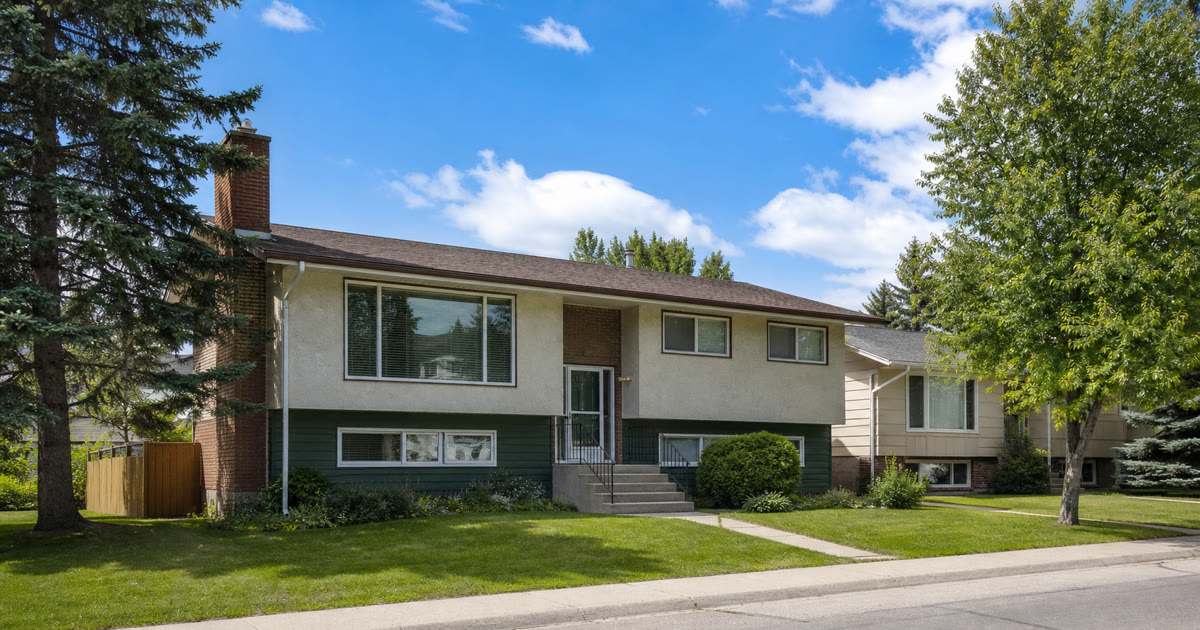
Radon in Calgary Split-Level and Bi-Level Homes: What Makes Them Different
Drive through any Calgary neighbourhood built between 1960 and 1985 — Brentwood, Haysboro, Acadia, Glamorgan, Thorncliffe, Huntington Hills — and you will see them on nearly every block: split-level and bi-level homes. They were the default Calgary floor plan for a generation. Practical, family-sized, and built by the thousands during Alberta's oil-boom decades.
If you own one of these homes, you know their quirks: the half-flight of stairs from the front door, the kitchen overlooking the family room a few steps down, the daylight basement that doesn't feel like a basement at all.
But here is what most Calgary split-level and bi-level owners do not know: that same floor plan that gives your home its character also gives radon more ways to enter — and more places to accumulate — than in a standard bungalow or two-storey.
What Makes a Split-Level Foundation Different
To understand the radon challenge, you have to understand the foundation. A standard Calgary bungalow sits on one continuous concrete slab with perimeter footings — one soil-contact surface, one radon entry plane.
A split-level is different. In a typical Calgary split-level:
- The lower level (family room, utility room) is a partial basement — a concrete slab set 3 to 4 feet below grade, with foundation walls on three or four sides.
- The mid-level (living room, kitchen) sits on a separate slab, roughly at grade or slightly above.
- The upper level (bedrooms) is over a crawlspace or sits on the same slab as the mid-level, depending on the variant.
- At the seams where these slabs meet — or where slab meets crawlspace, or where the garage slab abuts the lower-level foundation — there are construction joints. And every joint is a potential radon pathway.
A bi-level (raised bungalow) has its own variant: the basement is partially above grade, with large windows and a higher ceiling. The floor slab sits roughly 4 to 5 feet below grade, but the upper walls are backfilled. This creates a larger soil-contact envelope than a standard basement — more surface area for radon to diffuse through.
In both designs, you are not dealing with one uniform slab. You are dealing with a puzzle of concrete pours, each with its own relationship to the uranium-bearing glacial till that underlies Calgary and much of southern Alberta.
Why This Matters for Radon in Calgary
Radon enters a home through the path of least resistance. It moves from the soil — where it is generated by decaying uranium in the ground — into the lower-pressure environment of your house. In a standard home, radon has one primary entry surface: the basement floor slab.
In a Calgary split-level, radon has multiple options: the lower-level slab, the mid-level slab if it contacts soil, the crawlspace floor if it is dirt (common in older Calgary splits), the cold joint where the garage floor meets the lower level, the gap around the plumbing stack that passes through two or three different floor elevations.
More entry surfaces mean more potential radon. And because Calgary and Alberta sit on some of the most uranium-rich soils in Canada — thanks to the glacial till deposited during the last ice age — the source term is significant. Radon is not scarce here. It is abundant, and it is looking for a way in.
Adding to the problem: Calgary's cold-climate construction. Split-level and bi-level homes in Calgary were built with Alberta winters in mind — tight envelopes, vapour barriers, insulated basements. These are good things for energy efficiency. But they also trap radon that does get inside. The stack effect — warm air rising and pulling soil gas in from below — is particularly strong in a split-level because the vertical temperature gradient spans multiple half-storeys, creating a natural chimney.
Where Radon Accumulates in a Split-Level
This is the practical part. In a standard Calgary home, radon testing is straightforward: place the detector in the basement, in the lowest lived-in area. But in a split-level, "lowest" is not always obvious.
Consider a typical Calgary 4-level split in Acadia:
- Level 1 (lowest): partial basement — family room, laundry, furnace room. Concrete slab on grade. This is where you would expect the highest radon concentration, and often it is.
- Level 2: living room, dining room, kitchen — a half flight up from the family room. This slab may be above grade, but if it shares a cold joint with the lower slab or sits over a crawlspace, radon can migrate upward.
- Level 3: bedrooms — another half flight up. Radon concentrations here are typically lower, but not always negligible, especially in winter when the stack effect is strongest.
- Level 4: upper bedrooms — farthest from the soil source, usually the lowest readings.
A radon test placed only on Level 1 may capture the highest reading — but a family that spends evenings in the Level 2 living room and sleeps on Level 3 is breathing air from three different radon zones. Some Calgary split-level owners are surprised to find that a short-term test in the lower-level family room reads 180 Bq/m³, while the kitchen — just a few steps up and seemingly "above grade" — still holds 110 Bq/m³ because of interconnected air movement between levels.
This is not a theoretical scenario. In split-level homes, radon does not respect the half-flight staircase. Air moves freely between levels, and radon comes along for the ride.
Bi-Level Homes: The Raised Bungalow Trade-Off
Calgary bi-levels — those raised bungalows with the big basement windows you see across Haysboro and Brentwood — have a different radon profile. The basement is shallower, which means less soil-contact depth. In theory, that could mean less radon entry.
In practice, bi-level basements in Calgary often have larger floor plates than the upper level, extending under the attached garage or under a rear deck. That means more slab area in contact with soil. And because bi-level basements are often finished as bright, livable spaces — with large windows and proper drywall — Calgary families spend significant time there. A radon reading of 150 Bq/m³ in a bi-level basement that serves as the primary family room and home office is a more meaningful exposure than the same reading in a dark, unfinished storage basement that nobody uses.
Bi-level homes built in Calgary in the 1970s also frequently have a design feature worth noting: the furnace and water heater are often located in a mechanical closet on the main floor or in a small basement alcove, not in a dedicated utility room. This can create negative pressure zones that draw soil gas toward occupied areas more directly than in homes where mechanicals are isolated.
Testing a Split-Level or Bi-Level Home: Getting It Right
Health Canada's testing protocol is designed for standard configurations. For Calgary split-level and bi-level homes, adapt it with a few practical rules:
Place detectors on the lowest lived-in level — but consider a second detector
The standard advice — test the lowest level that is occupied for at least four hours per day — is a good starting point. In a split-level, this is usually the lower family room or basement. But in a Calgary home where the family lives across three half-levels, placing a second detector one level up provides a more complete picture. A single detector in the lower level may overstate whole-home exposure if nobody sleeps there; a single detector on the mid-level may miss the highest concentration entirely.
Test during heating season — Calgary's October through April window
This applies to all Calgary homes, but it is especially important for split-levels. The stack effect — radon's engine — is strongest when outdoor temperatures drop and the furnace runs. A summer test in a Calgary split-level can under-read by 30 to 50% compared to a winter test. Health Canada recommends a minimum 90-day test during heating season for the most reliable result. In Calgary, this means starting the test in October or November and letting it run through January at least.
Do not place detectors near stairwells, doors, or windows
In a split-level, the half-flight staircase acts as an air highway between levels. Placing a detector too close to the stairs can produce a reading that averages two different radon zones and helps neither. Place detectors at least 50 cm from any stair opening, exterior door, or window. The ideal spot is at breathing height — roughly 1 to 1.5 metres above the floor — in a location where people actually sit or sleep.
After renovations — test again
Calgary split-level owners frequently renovate: finishing the lower-level family room, adding a bathroom in the basement, knocking down walls between the kitchen and living room. Any renovation that disturbs the slab, opens walls, or alters airflow between levels can change the home's radon profile. A home that tested at 80 Bq/m³ before a basement renovation may read 160 Bq/m³ afterward because a new drain rough-in cracked the slab and opened a fresh pathway from the soil.
Mitigating Radon in a Split-Level: One System or Two?
This is the question Calgary split-level owners ask most often: does my home need one radon mitigation system, or more than one?
The answer depends on the specific split-level configuration, but here is the general guidance from the C-NRPP mitigation standard applied to Calgary's housing stock.
Standard 3-level or 4-level split (side split or back split)
Most Calgary split-levels can be effectively mitigated with a single sub-slab depressurization system installed in the lowest-level slab. The fan creates negative pressure under the lowest concrete floor, capturing radon before it enters the home and exhausting it above the roof line.
However, the contractor must verify that the suction field extends under all slab sections. In some Calgary splits, the lower-level slab and mid-level slab are structurally separate pours — not just different elevations but physically disconnected. If the suction field does not communicate between them, a second suction point on the mid-level slab may be needed. A good C-NRPP certified mitigator in Calgary will test suction-field communication with a micromanometer during the diagnostic visit — before cutting any holes.
Split-level with a dirt crawlspace
Some older Calgary split-levels — particularly those built in the early 1960s in neighbourhoods like Brentwood and Glamorgan — have a dirt-floor crawlspace under the mid-level instead of a concrete slab. In this case, the crawlspace requires a sub-membrane depressurization approach: a sealed polyethylene membrane over the dirt, with a suction pipe beneath it connected to the radon fan. This is installed alongside the sub-slab system for the lower-level basement.
Bi-level with an attached garage
Many Calgary bi-levels have an attached garage where the garage slab was poured separately from the basement slab. The cold joint between the two is a common radon entry point — and garage slabs in Calgary are rarely sealed for radon. A thorough mitigation system in a bi-level includes sealing accessible slab cracks and construction joints in addition to the sub-slab depressurization system.
Cost considerations for Calgary split-level owners
A single sub-slab depressurization system in a standard Calgary split-level typically falls within the same cost range as a bungalow mitigation. If a second suction point or sub-membrane system is needed, costs increase accordingly. The diagnostic visit — where the mitigator assesses suction-field communication and identifies the optimal suction point — is essential. In a split-level, skipping the diagnostic and assuming a single point will cover all slab sections is the most common cause of incomplete mitigation.
Case Study: A Calgary 4-Level Split in Haysboro
Consider a 1974 4-level split in Haysboro, Calgary. The homeowners — a couple with two school-age children — tested their home with a 90-day alpha-track detector placed in the lower-level family room during the 2024–2025 heating season. Result: 210 Bq/m³. Above the Health Canada guideline of 200 Bq/m³.
During the diagnostic visit, the C-NRPP certified mitigator found:
- The lower-level slab (family room) and mid-level slab (living room/kitchen) were physically separate pours with a construction joint that had opened over 50 years of Calgary freeze-thaw cycles.
- The suction field from a test hole in the lower-level slab did not extend to the mid-level slab.
- The mid-level reading — taken during the diagnostic — was 140 Bq/m³.
The solution: two suction points connected to a single exterior radon fan, with the pipework routed through the lower-level utility closet and exhausted above the roof. Post-mitigation readings: lower level dropped to 28 Bq/m³, mid-level to 18 Bq/m³. The family now sleeps in a home where radon is no longer a concern.
This case is not unusual. Many Calgary split-levels built in the 1970s and early 1980s have similar slab configurations. The key is the diagnostic — testing suction-field communication before committing to the system design.
Why Calgary's Building Boom Created This Radon Blind Spot
Between 1960 and 1985, Calgary added over 150,000 housing units — the bulk of them split-level, bi-level, and bungalow designs in new suburban neighbourhoods spreading outward from the city core. The focus was on speed, affordability, and floor plans that fit growing families. Radon was not on anyone's radar. The first widespread radon testing in Alberta did not begin until the late 2000s, and Health Canada's Cross-Canada Radon Survey — which included Calgary — was published in 2012.
That means the vast majority of Calgary's split-level and bi-level housing stock was designed and built without any radon-resistant construction techniques. No sub-slab gravel layer with a stub pipe. No sealed foundation joints. No gas-tight sump lids. Just a concrete slab poured on glacial till, with nothing between the soil gas and the family room.
Today, Calgary homeowners in these homes are retroactively discovering that a floor plan they love also created radon pathways they never knew existed. The good news: those pathways can be closed. Modern sub-slab depressurization works as well in a 1973 split-level as it does in a brand-new detached home — it just requires a more careful diagnostic step.
Practical Steps for Calgary Split-Level and Bi-Level Owners
If you own a split-level or bi-level home in Calgary or Alberta, here is what to do this year:
1. Test — even if you tested five years ago
Radon levels change over time as your foundation ages. Calgary's aggressive freeze-thaw cycles widen hairline cracks into real openings. A home that tested at 90 Bq/m³ in 2019 may read 160 Bq/m³ today. If you have not tested in the last three years, order a long-term test and place it in your lowest lived-in level during the upcoming heating season.
2. Use a long-term test — 90 days minimum
Short-term tests of 48 to 96 hours are snapshots, and radon levels fluctuate daily and seasonally. In Calgary's variable winter climate — where a chinook can swing outdoor temperatures by 20°C in an afternoon — a short test may catch an unusually low or high moment. A 90-day alpha-track test averages out the noise and gives you a number you can act on.
3. If you are renovating — test before you start
Basement finishing, slab cutting, sump pump installation, or any work that disturbs the foundation floor can open new radon pathways. Test beforehand so you know your baseline. If levels are already elevated, incorporate a radon mitigation system into the renovation plan — it is far easier to install pipework before drywall goes up.
4. Hire a C-NRPP certified professional who understands split-levels
Not every radon mitigator in Calgary has experience with split-level and bi-level homes. During your consultation, ask specifically: "How many split-level homes have you mitigated in Calgary? How do you test suction-field communication between separate slab pours?" A C-NRPP certified professional who answers these questions clearly and confidently is the one you want.
5. Monitor after mitigation
A well-designed system in a Calgary split-level should bring radon below 50 Bq/m³ — often below 30. Use a digital radon monitor to confirm that the system is performing as designed, and re-test with a long-term detector every two years. Your radon fan runs 24 hours a day; knowing it is doing its job is worth the small investment in a monitor.
Calgary Neighbourhoods Where This Matters Most
Split-level and bi-level homes are not evenly distributed across Calgary. They are concentrated in the ring of neighbourhoods developed during the city's post-war expansion through the 1980s. If you live in any of the following Calgary communities, your home is statistically more likely to be a split-level or bi-level — and the radon considerations in this article apply directly to you:
- Brentwood — 1960s, heavy concentration of splits and bi-levels
- Haysboro — 1960s–1970s, many 4-level splits
- Acadia — 1960s, predominantly split-level
- Glamorgan — 1960s, mix of splits and bungalows
- Thorncliffe — 1960s–1970s, split-level and bi-level
- Huntington Hills — 1970s, bi-levels and splits
- Marlborough — 1970s, many split-level designs
- Braeside — 1970s, split-level and bi-level mix
- Southwood — 1960s–1970s, split-levels throughout
- Banff Trail — 1960s, bi-levels and bungalows
This is not an exhaustive list — many other Calgary neighbourhoods from this era share the same housing stock. The point is: if your Calgary home was built between 1960 and 1985 and has multiple half-flights of stairs, this article is written for you.
The Bottom Line
Calgary's split-level and bi-level homes are well-built, family-friendly, and deeply woven into the character of the city's older neighbourhoods. They are not inherently more dangerous than any other home type when it comes to radon — but they are more complex. More slab sections. More construction joints. More potential entry points. And more places where radon levels can differ from room to room.
Testing is the only way to know your home's radon level. For split-level and bi-level owners in Calgary and Alberta, that test should account for the unique geometry of your floor plan: test the lowest lived-in level, consider a second detector, and use a full 90-day test during heating season.
If your levels come back high — above Health Canada's 200 Bq/m³ guideline — a sub-slab depressurization system designed for your specific split-level configuration can bring them down to a small fraction of the guideline, usually in a single day of installation. The technology is proven. It just needs to be applied with an understanding of how your particular Calgary home was built.
Radon is the second leading cause of lung cancer in Canada, responsible for an estimated 3,200 deaths per year. For Calgary families living in the split-levels and bi-levels that define the city's mid-century neighbourhoods, awareness, testing, and — when needed — professional mitigation are the difference between an avoidable risk and peace of mind.
Related radon guides
Why Winter Radon Levels Spike in Calgary Homes
Radon levels often peak in winter. Learn why Calgary's cold-climate homes draw more radon indoors and why heating season is the best time to test.
DIY Radon Test Kits vs Professional Testing: Which Is Right for You?
Compare DIY radon test kits and professional radon testing in Calgary, including accuracy, cost, and when each option makes sense.
Understanding Radon Levels: Becquerels and the 200 Bq/m³ Guideline
What does your radon test number mean? Understand becquerels, the Health Canada 200 Bq/m³ guideline, and how to interpret your result.