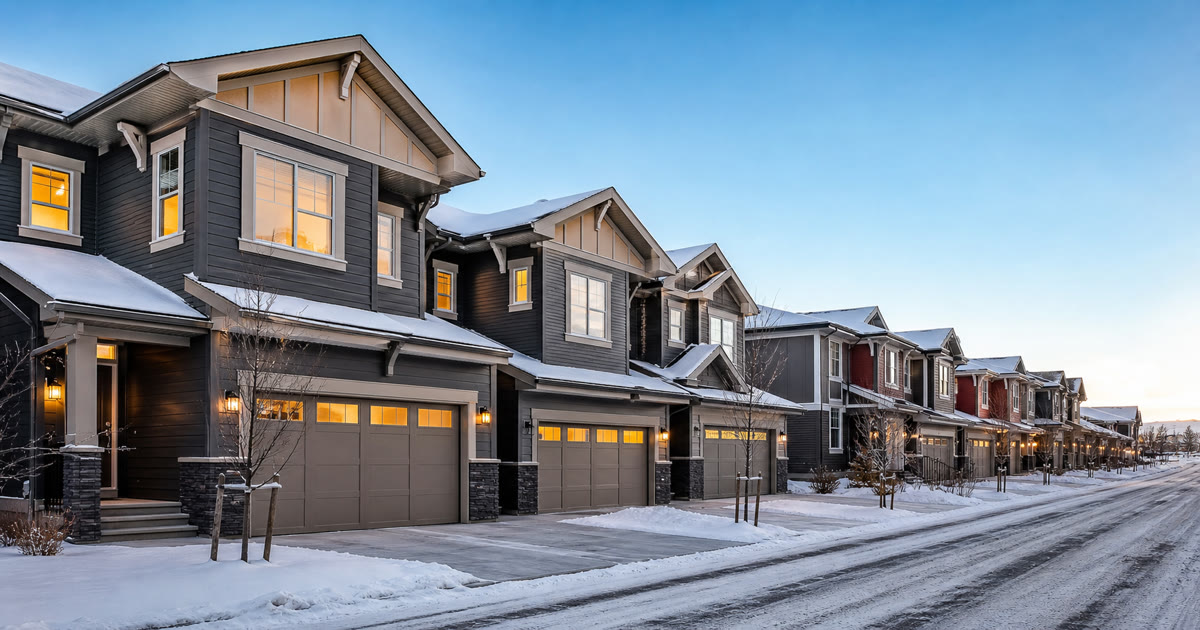
If you own a townhouse or row house in Calgary, you have probably heard the usual radon warnings — and dismissed them. Radon is a detached-home problem, the thinking goes. It only matters if you have a basement. My townhouse sits on a concrete slab. I share walls with neighbours. How much soil gas can possibly get in?
The answer, unfortunately, is: more than you think. Calgary townhouses and row houses face a distinct set of radon risks that are neither well publicized nor widely understood — even by many owners themselves. If you live in a Calgary neighbourhood like Mahogany, Seton, Evanston, Sage Hill, or any of the dozens of Calgary communities where attached homes have multiplied in the last two decades, this article is for you.
In a standard detached Calgary home, the entire footprint sits on soil. Radon enters through the basement slab, the foundation walls, the sump pit, and any crack or penetration in the concrete. The physics is straightforward: the stack effect pulls soil gas upward through the whole foundation area.
A Calgary townhouse is different in several important ways, and each of these differences affects radon behaviour:
Not all townhouses in Calgary sit on the same kind of foundation. You will find three common configurations across Calgary's attached housing stock:
Each of these foundation types creates different entry patterns for radon, and none of them is immune. A slab-on-grade townhouse in Calgary does not avoid radon — it simply receives it at floor level instead of in a basement.
This is one of the least-studied aspects of radon in Canadian attached housing. When two Calgary townhouse units share a below-grade wall, the soil gas pressure field beneath both units is connected. A mitigation system in Unit A may influence radon levels in Unit B — for better or worse.
The practical implication for Calgary townhouse owners is clear: if your neighbour tests high and you have not tested at all, you are flying blind. The soil that produces radon does not respect property lines, and neither does the pressure field beneath a row of attached homes. In a row of five townhouses in Falconridge, for example, it is entirely possible that three units have elevated radon while two do not — or that all five share the same problem to varying degrees.
A typical Calgary townhouse has a smaller building footprint than a detached home. Does this mean less radon? Not necessarily. The stack effect — the upward pull created by warm indoor air rising — is driven by height and temperature difference, not by square footage. A three-storey townhouse with a heated interior and a cold Calgary winter outside pulls air upward with the same physics as a detached two-storey house. The reduced footprint means the soil gas entering the home is concentrated in a smaller area at ground level.
In a slab-on-grade Calgary townhouse, the area where you sit, cook, and sleep is in direct contact with the concrete that sits on radon-emitting soil. There is no basement to act as a buffer.
The geological reason that radon is a concern across Calgary is well established. Calgary and much of southern Alberta sit on uranium-bearing glacial till and sedimentary bedrock. As uranium decays, it produces radium — and radium, in turn, produces radon gas. This radon migrates upward through soil, enters the air, and can accumulate in any enclosed space in contact with the ground.
This geological fact applies equally to townhouses, row houses, duplexes, semi-detached homes, and detached homes across Calgary. The soil beneath a townhouse row in Evanston is the same geology as the soil beneath a detached bungalow in Brentwood. Radon does not check your title deed before it rises.
Health Canada's Cross-Canada Radon Survey identified the Prairie region — including Calgary and all of Alberta — as having a higher percentage of homes above the 200 Bq/m³ guideline than the national average. Nationally, approximately 7% of homes exceed the guideline; in the Prairie provinces, the percentage is higher. [ПРОВЕРИТЬ: точный процент по Prairie region из Cross-Canada Survey] With tens of thousands of townhouses across Calgary communities, the number of attached homes potentially affected is substantial.
Since 2015, Alberta's building code has required a radon rough-in for new homes — including townhouses. A radon rough-in is a PVC pipe stub through the foundation slab, capped and labeled, ready to be connected to a mitigation fan and vent stack if testing reveals elevated radon.
For Calgary townhouse owners, this is both good and incomplete news. The good: a rough-in means the builder made one part of the mitigation equation easier. The incomplete: a rough-in is not a test, not a guarantee, and not an active mitigation system. It is a future-proofing measure that sits idle until you verify your actual radon levels.
If your Calgary townhouse was built before 2015, you likely do not have a rough-in — and even if you do, you still need a long-term test to know your levels. Age of the building is irrelevant to radon: a brand-new townhouse in Livingston can have exactly the same radon problem as a 1980s row house in Falconridge.
One of the most common barriers Calgary townhouse owners face is not technical — it is administrative. Many townhouse developments in Calgary are part of a condo corporation or homeowners' association (HOA) with rules about exterior modifications. A radon mitigation system typically requires:
Each of these may require strata or HOA approval in Calgary. If your townhouse shares a wall with another unit, the exterior pipe routing may also cross or border common property.
This is a solvable problem, but it requires communication. A well-prepared Calgary townhouse owner approaching their strata board with radon test results and a clear mitigation plan is far more likely to get approval than someone who asks in the abstract. Some key points to have ready:
In Alberta, radon awareness has grown significantly in recent years, and many Calgary condo boards and HOAs now recognize radon mitigation as a necessary health measure, not an aesthetic preference.
Testing a townhouse in Calgary follows the same Health Canada protocol as any other home, but a few townhouse-specific considerations apply:
Health Canada recommends placing the radon detector in the lowest lived-in level of the home where occupants spend at least four hours per day. In a detached Calgary home, this is typically the basement. In a slab-on-grade townhouse, the lowest level is the ground floor — your living room, kitchen, or home office. Place the detector there, away from drafts, exterior walls, and direct sunlight.
For a townhouse with a basement, the basement is the correct placement — unless it is unfinished and nobody spends time there. In that case, test the ground floor as well, or test both levels.
A 90-day or longer test during Calgary's heating season — October through April — gives the most reliable result. Short-term tests of a few days or a week can miss spikes and seasonal variation. Calgary's winter stack effect is strong, Chinook pressure swings are frequent, and radon levels can rise and fall dramatically. A long-term test smooths out these fluctuations.
Radon levels can vary significantly between adjacent units in a Calgary row house. Your neighbour's result — whether high or low — tells you nothing about your own unit. Different foundation penetrations, different slab conditions, different HVAC configurations, and different occupancy patterns all affect radon entry and accumulation. The only reliable number is the one from your own test.
If your Calgary townhouse tests above 200 Bq/m³, the gold-standard mitigation solution is the same as for a detached home: sub-slab depressurization (SSD). A C-NRPP certified professional cores a hole through the concrete slab, runs a PVC pipe upward, and installs a continuously operating fan that pulls soil gas from beneath the slab and vents it safely above the roofline.
In a Calgary townhouse, the specifics depend on the build:
The penetration is made through the ground-floor slab — often in a mechanical closet, under the stairs, or through an attached garage floor. The pipe runs up through the interior or an attached garage and exits through the roof or an exterior wall above the roofline. The fan is typically mounted in the attic, in the garage, or on the exterior of the building.
This is a straightforward installation in most Calgary townhouses, though the exterior vent routing may need strata/HOA sign-off.
The SSD system works as it does in any Calgary detached home: a penetration through the basement slab, pipe routed through the house or up an exterior wall, fan mounted in the attic or on the exterior. If the basement shares a foundation wall with a neighbouring unit, the certified professional must assess whether the pressure field extends under both units and adjust the system design accordingly.
Some Calgary row houses have flat roofs or limited attic space. In these cases, the vent pipe may run up an exterior wall — similar to a furnace or water heater vent. A C-NRPP certified professional in Calgary will design the system to meet both building code and the practical constraints of the structure.
Radon mitigation costs in Calgary vary with the complexity of the installation. Townhouse mitigations that require strata approval, exterior routing, or special access considerations may differ from a standard detached-home installation. [ПРОВЕРИТЬ: типичный диапазон цен для townhouse mitigation в Calgary] Onyx Radon provides site-specific quotes after an on-site assessment — no two Calgary townhouses are identical, and the quote reflects the actual job, not an estimate.
Consider two real scenarios from Calgary neighbourhoods:
Owner A lives in a 2018 slab-on-grade townhouse in Seton, Calgary's fast-growing southeast community. The home has a radon rough-in under the stairs. After hearing about radon from a neighbour, they run a 90-day test during winter and get 310 Bq/m³ — well above the Health Canada guideline. Because a rough-in is already in place, the mitigation installation takes less than a day. Post-mitigation, the level drops to 18 Bq/m³. The HOA approved the exterior vent because the owner presented test results and a C-NRPP professional's proposal.
Owner B lives in a 2003 row house in Brentwood with a finished basement. No rough-in exists. After reading about radon in Alberta, they test and get 180 Bq/m³ — in the grey zone below the guideline but above 100. Because the basement is a home office and kids' playroom, they decide to mitigate. The installation requires coring a new hole through the basement slab, routing pipe through a closet and the attic, and mounting a fan on the exterior. Post-mitigation, the level drops to 25 Bq/m³. Peace of mind: achieved.
Neither owner panicked. Both tested. Both acted. That is the Calgary townhouse radon playbook in two steps.
Here is a practical five-step checklist for any Calgary townhouse or row house owner:
Radon does not care whether your Calgary home is detached, attached, stacked, or standing alone. It is a gas that rises from the soil, and any building in contact with that soil — townhouse, row house, duplex, or detached — can accumulate it.
Calgary townhouse owners have tested their homes and found levels above the Health Canada guideline. Calgary townhouse owners have installed mitigation systems and brought those levels down. The process works exactly the same way as it does for any other Calgary home: test, assess, mitigate if needed. The only difference is a few extra administrative steps with the strata or HOA — and those are solvable with preparation.
If you own a townhouse or row house in Calgary and have never tested for radon, the most important step is the first one. Order a test. Place it correctly. Let it run through the winter. Then you will have the one thing no article — including this one — can give you: your own number. From there, the rest is just plumbing.
Onyx Radon is C-NRPP certified and provides professional radon testing and mitigation for townhouses, row houses, condos, and detached homes across Calgary and Alberta. If you own an attached home and are concerned about radon, we offer free on-site assessments and quotes — with experience navigating strata and HOA approvals. Request a free quote →