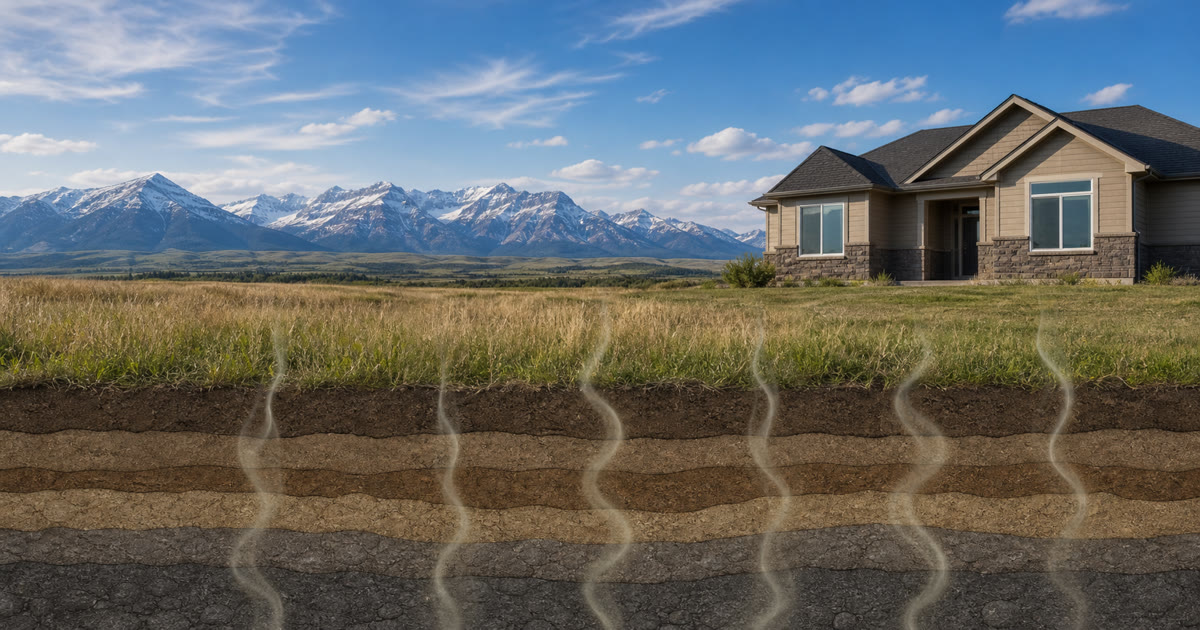
When Did Radon Become a Concern in Alberta? A Timeline of Awareness and Action
Radon feels like a recent discovery in Alberta, but the science behind it is older than most people realize. The gas itself has been rising from the soil beneath Calgary for millennia. What changed — and relatively recently — is that we started measuring it, understanding what it does to human lungs, and building the infrastructure to do something about it.
This is the story of how radon went from an obscure scientific footnote to a household conversation in Alberta.
The Early Science: Radon Identified
Radon was discovered as a distinct element in 1900 by German physicist Friedrich Ernst Dorn, who called it "radium emanation." But its connection to lung cancer would not be established for decades.
The critical breakthrough came from uranium mining. By the mid-20th century, researchers had documented alarmingly high rates of lung cancer among underground miners — in uranium mines in Czechoslovakia, in the Colorado Plateau, and in Elliot Lake and Uranium City in Canada. The common factor was not ore dust but radon gas and its radioactive decay products, which miners were inhaling in poorly ventilated shafts.
By the 1970s and 1980s, scientists began asking a new question: if radon causes lung cancer in mines, what about radon in homes?
The 1980s: The North American Wake-Up Call
The event that turned residential radon into a public issue happened in the United States. In 1984, Stanley Watras, a construction engineer at the Limerick nuclear power plant in Pennsylvania, repeatedly set off the plant's radiation detectors — on his way into work, not out. The radiation was coming from his house. His home's radon level was staggeringly high — roughly equivalent to what uranium miners were exposed to. The Watras home became a national news story, and the U.S. Environmental Protection Agency launched its radon program shortly after.
Canada was watching. By the late 1980s, Health Canada and various provincial agencies had begun preliminary surveys of residential radon, including measurements in Alberta.
The 1990s Through 2007: Building the Framework
Through the 1990s, radon research in Canada advanced piece by piece. Studies in Winnipeg, Saskatchewan, and parts of British Columbia confirmed that residential radon was not just an American problem. Alberta's geology — uranium-bearing sedimentary rock and glacial till across much of the province — made it a candidate for elevated levels, but systematic province-wide data was still sparse.
The watershed moment for Canadian radon policy came in 2007, when Health Canada lowered the national radon guideline from 800 Bq/m³ to 200 Bq/m³. This was a dramatic shift. The new 200 Bq/m³ threshold aligned Canada more closely with international recommendations, including those of the World Health Organization (which recommends a reference level of 100 Bq/m³ where achievable).
The 2007 guideline change was accompanied by a national push for testing. Health Canada launched the Cross-Canada Radon Survey, a multi-year effort to measure radon levels in tens of thousands of homes across every province and territory. For the first time, Alberta homeowners had access to large-scale, statistically meaningful data about radon in their own region.
2009–2011: The First Cross-Canada Survey Puts Alberta on the Map
The results of the first major Cross-Canada Radon Survey confirmed what geologists suspected: Alberta was among the higher-risk provinces.
In Calgary specifically, a meaningful percentage of homes tested above the 200 Bq/m³ guideline. The numbers were not extreme in every neighbourhood — radon is famously variable, and low readings sit right next to high readings — but the aggregate data showed that Alberta homeowners could not assume they were in the clear.
Around the same time, researchers at the University of Calgary began contributing to the growing body of radon science. The university's Radon Research Group, led by Dr. Aaron Goodarzi, would become one of Canada's leading radon research centres, producing studies on Alberta-specific radon risk factors, building types, and mitigation effectiveness.
The 2010s: Awareness Grows, but Slowly
Despite the data, radon awareness among Alberta homeowners grew unevenly through the 2010s. The real estate industry was an early adopter — realtors in Calgary began encountering radon as a topic during home inspections and transactions, and by the mid-2010s it was not uncommon for buyers to request radon testing as part of their conditions.
But among the general public, radon remained niche. Surveys found that a significant majority of Canadian homeowners had never tested — and many had never heard of radon.
The adoption of the Alberta Building Code's radon rough-in requirement for new construction was another milestone. All new homes in Alberta must now include a radon rough-in: a sealed pipe running from below the foundation slab to the attic, ready for a fan to be installed if testing later reveals elevated levels.
2024: The New Cross-Canada Survey Confirms the Risk
The 2024 Cross-Canada Survey of Radon Exposure in Residential Buildings found that approximately 17.8% of Canadian residential properties have radon levels at or above 200 Bq/m³. In Calgary, roughly 15.5% of homes exceeded the guideline, with an average reading of 102.5 Bq/m³ across the city.
The 2024 survey highlighted something alarming: the percentage of homes above the guideline appeared to be rising compared to the earlier survey. Researchers pointed to several possible explanations: tighter home construction for energy efficiency (which traps radon), more testing in high-risk regions, and potentially changing soil gas dynamics. Regardless of the cause, the message from the 2024 data was clear: radon was not going away, and in Alberta, it deserved more attention, not less.
Where Alberta Stands Today
As of 2026, radon awareness in Alberta is higher than it has ever been, but the gap between awareness and action remains. Testing is straightforward and affordable — a long-term DIY test kit costs roughly $40 to $60 — yet the majority of Calgary homes are still untested.
Several factors are pushing awareness forward. The real estate market has integrated radon testing into a growing share of transactions. The University of Calgary's continued research keeps the issue in the public eye. Health Canada's messaging has been consistent: test, and if levels are above 200 Bq/m³, mitigate.
At the same time, Alberta has not made radon testing or disclosure mandatory in real estate transactions, and landlords are not required to test rental properties. Advocacy groups continue to push for stronger policy, but for now, the responsibility sits with individual homeowners.
Why the History Matters
Understanding the timeline matters because radon is not a new threat — it is an old one that we have only recently learned to measure and manage. Every policy milestone, from the 2007 guideline change to the 2024 Cross-Canada Survey, has moved Alberta closer to a reality where no family lives with elevated radon without knowing it.
The science is settled. The mitigation is proven. The remaining work is getting every Calgary home tested — one property at a time.
The Bottom Line
Radon has been present in Alberta homes for as long as there have been foundations on uranium-bearing soil. What changed starting in the 1980s, and accelerating through 2007 and 2024, is our ability to measure it, understand the health risk, and remove it. Today, a Calgary homeowner can test for under $60 and fix a high reading with a one-time mitigation investment.
If your home has never been tested, that is the next step. At Onyx Radon, our C-NRPP certified team provides testing and mitigation for Calgary and Alberta homeowners. Know your number — it has never been easier to check, and it has never mattered more.
Related radon guides
Sump Pump Pits: Calgary's Hidden Radon Entry Point
Your sump pump pit could be a direct pathway for radon to enter your Calgary home. Learn how to identify the risk, seal it properly, and protect your family from this invisible gas.
Radon in Energy-Efficient Calgary Homes: The Airtight Paradox
Energy-efficient airtight homes in Calgary can trap more radon, not less. Learn why sealing your home against cold may increase radon levels and what to do about it.
Radon in Calgary Condos and Apartments: What Every Multi-Unit Resident Should Know
Think your Calgary condo is safe from radon? Ground-floor and basement units can have dangerous levels. Here's what condo owners, renters, and strata boards need to know about testing and mitigation.