Radon Grey Zone 100–200 Bq/m³: What Calgary Homeowners Should Actually Do
You did the right thing — you tested your home for radon. The results are in: somewhere between 100 and 200 Bq/m³. You are under the Health Canada guideline of 200 Bq/m³, so technically you passed. But you also feel uneasy. Is a number in the 100s really safe, especially when your family spends hours every day in the basement of your Calgary home?
You have entered the radon grey zone — and thousands of Calgary and Alberta homeowners are in it with you. This guide walks through what the numbers mean, what your actual risk is, and how to make a clear-headed decision about whether to mitigate.
What the Grey Zone Is
The "grey zone" refers to indoor radon readings between roughly 100 and 200 Bq/m³. These levels fall under Health Canada's remediation guideline of 200 Bq/m³, meaning the federal government does not specifically require you to act. But they are also well above outdoor background levels and far from zero.
To put the numbers in perspective:
- Outdoor ambient radon in Calgary and across Alberta typically measures 10–30 Bq/m³.
- The World Health Organization (WHO) recommends a reference level of 100 Bq/m³ — half of Health Canada's guideline — for countries establishing new radon programs.
- A home reading 150 Bq/m³ has roughly 10 times the radon concentration of outdoor air in Calgary.
So when your Calgary home reads 140 or 170 Bq/m³, you are not in immediate danger — but you are also not breathing outdoor-quality air. You are in a zone where the risk is real, measurable, and worth your attention.
Health Canada's Position: The Guideline Is 200, but Lower Is Better
Health Canada's guideline of 200 Bq/m³ is not a "safe vs. unsafe" line. It is a practical threshold — the level at which the benefit of taking action clearly outweighs the cost for most Canadian homes. The agency explicitly advises homeowners to reduce radon as low as reasonably achievable, a principle known as ALARA.
This means a Calgary household at 190 Bq/m³ is within the guideline, but Health Canada would still say: if you can lower it further, you should consider it. The risk scale does not have a cliff at 200 — it rises steadily with every additional becquerel.
What the Risk Actually Looks Like in the Grey Zone
Radon is the second leading cause of lung cancer in Canada, responsible for an estimated 3,200 deaths per year nationwide. The risk is cumulative — it builds over years of exposure, not days. The higher the concentration and the longer the exposure, the greater the lifetime risk.
At levels between 100 and 200 Bq/m³, the lifetime lung cancer risk for a non-smoker is low in absolute terms — but it is not zero. For a smoker, the combined effect of tobacco and radon multiplies the risk substantially. If your Calgary household includes a smoker, or someone who smoked in the past, the grey zone becomes a much sharper concern.
Children are another factor. Their lungs are still developing, and their respiratory rate is higher relative to body size. A family in a Calgary neighbourhood like Brentwood or Haysboro whose kids spend hours in a basement playroom at 160 Bq/m³ is exposing them to a cumulative risk that is entirely avoidable.
Why Calgary Homes Often Land in the Grey Zone
Calgary and southern Alberta sit on uranium-bearing glacial till and sedimentary soils — geology that naturally produces radon. Combine that with Calgary's cold-climate construction: tightly sealed homes with basements, furnaces that run half the year, and the stack effect that pulls soil gas upward through the foundation during every heating season.
It is common for Calgary homes to test in the 100–200 range. A home in Acadia built in the 1970s, or a newer build in Falconridge, may both land in the grey zone — sometimes right at the edge of the guideline. A single long-term test during Calgary's winter months gives the most reliable reading; a short test in summer may under-read significantly.
Three Questions to Guide Your Decision
If your Calgary home is in the grey zone, work through these three questions. They are designed to push past the abstract numbers and anchor the decision in your actual life.
1. Who lives in your home — and where do they spend their time?
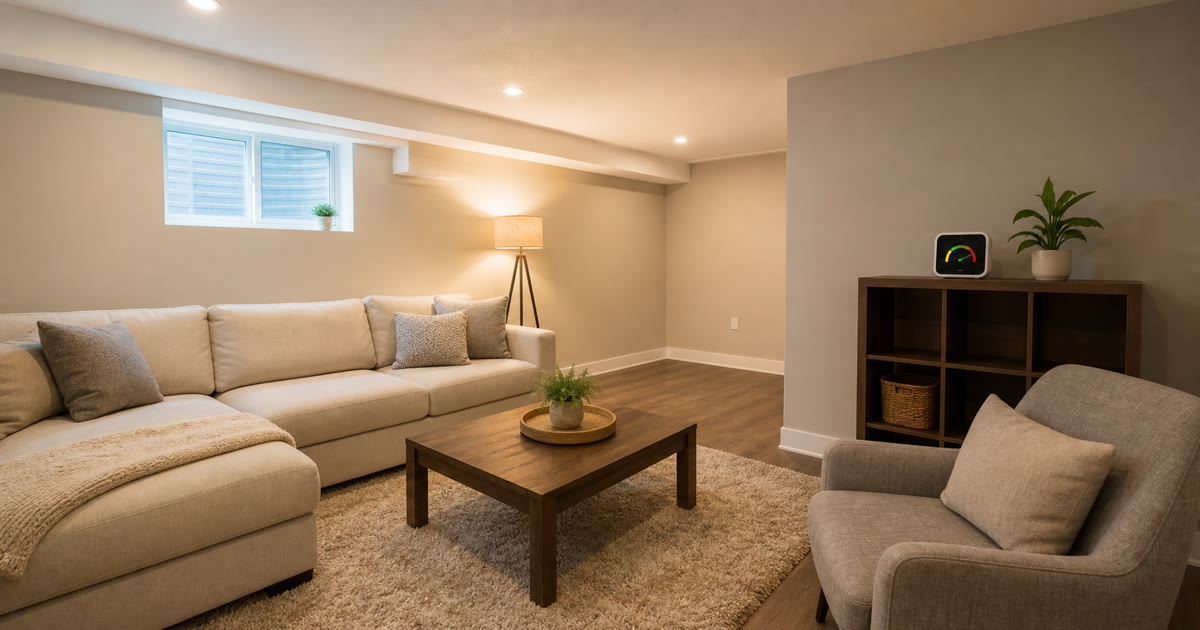
A couple in their forties who rarely use the basement faces a different equation than a family with young children whose playroom, home theatre, or guest suite is below grade. In Calgary homes, basements often function as full living spaces — especially during the long winter months when outdoor play is limited. If your basement is lived in, the grey zone is more urgent.
2. How long was your test — and when was it taken?
A 90-plus-day test during Calgary's heating season (October through April) is the gold standard. It captures the stack effect at full force and gives you a reliable annual average. A short-term test of a few days, or a test taken during a warm chinook spell in January, may under-represent your true exposure. If you are in the grey zone based on a short test, the logical next step is a long-term confirmation test before making a mitigation decision.
3. What would mitigation cost — and what is peace of mind worth?
A professional sub-slab depressurization system in a typical Calgary home costs a fraction of what you would pay for a new furnace or a foundation repair. Once installed, it runs continuously on a small fan that costs roughly the same as a bathroom exhaust to operate. Most importantly, a well-designed system will reliably bring radon down to levels below 50 Bq/m³ — often below 30. For a Calgary homeowner at 170 Bq/m³, that means cutting exposure by 80% or more for a one-time investment.
What If You Choose Not to Mitigate?
Staying in the grey zone without mitigation is a valid choice — but it should be an informed one, not a default. If you decide against a system, commit to:
- Re-testing every two to three years, because radon levels shift as your foundation ages, cracks develop, and your home settles. Calgary's freeze-thaw cycles are aggressive on concrete.
- Re-testing after any basement renovation, especially if you break the slab, move walls, or alter HVAC ductwork. A renovation that was meant to improve your home can inadvertently open new radon pathways.
- Monitoring with a digital radon detector to catch spikes — particularly during Calgary's winter when the stack effect is strongest and levels can temporarily climb above the guideline.
When to Move from "Wait" to "Act"
Some signals push the grey zone decision firmly toward mitigation:
- Your long-term test result is consistently above 150 Bq/m³ and trending upward.
- Your household includes a smoker or former smoker — the combined risk is synergistic, not additive.
- Your basement is a primary living area in your Calgary home.
- You are planning to sell in the next few years. A pre-listing radon test showing 180 Bq/m³ will be a negotiation point for any informed buyer in Alberta. Mitigating before listing removes that variable entirely.
A Grey Zone Decision for a Real Calgary Neighbourhood
Consider a home in Brentwood, Calgary — a 1960s bungalow with a finished basement where the homeowners run a home office and a kids' TV room. A long-term winter test returns 165 Bq/m³. No one smokes. The home is below the Health Canada guideline, but two children spend 20 hours a week in the basement during the school year. The homeowners choose to install a sub-slab depressurization system. Post-mitigation, the level drops to 22 Bq/m³ — a reduction of over 85%. The family no longer thinks about radon.
That is what the grey zone decision actually looks like in Calgary and Alberta: not a crisis, not a panic, just a clear-eyed investment in reducing a known, preventable cancer risk.
The Bottom Line
The radon grey zone is real, and it is uncomfortable because it lacks a bright-line rule. Health Canada says 200 Bq/m³ is the action level — and that is the right framework for public policy. But your home is not a policy document. It is where your family sleeps every night in Calgary.
If your reading is between 100 and 200 Bq/m³, the decision is yours — but it should be an active decision, not a shrug. Ask the three questions. Run a long-term confirmation test. Understand what mitigation costs and what it delivers. And remember: in radon, the goal is not to be "under the guideline." The goal is to be as low as you can reasonably get.
Related radon guides
Radon and Home Insurance in Calgary: What's Covered and What Homeowners Should Know
Does home insurance in Alberta cover radon testing or mitigation? Calgary homeowners need to know what their policy actually protects — and what it does not.
Sump Pump Pits: Calgary's Hidden Radon Entry Point
Your sump pump pit could be a direct pathway for radon to enter your Calgary home. Learn how to identify the risk, seal it properly, and protect your family from this invisible gas.
Radon in Energy-Efficient Calgary Homes: The Airtight Paradox
Energy-efficient airtight homes in Calgary can trap more radon, not less. Learn why sealing your home against cold may increase radon levels and what to do about it.